
Table of Contents
This regulatory comment was originally submitted under the title Comments Submitted on The Proposed Revision to 704 KAR 8:060, Which Incorporates by Reference the Kentucky Academic Standards for Social Studies Dated August, 2026.
Introduction
While the proposed Kentucky Academic Standards for Social Studies dated August 2026 (hereafter the “proposed standards”) contain some improvements over the December 2022 standards currently in use, many major problems remain. These can be summarized as follows:
- The improper basic organization of the proposed standards, incorporating massive amounts of Disciplinary Clarifications instead of solid and unambiguous declarations of what will be learned, makes it difficult to determine what students are actually expected to know and be able to do. This format is not suitable for a standards document.
- The proposed standards fail to clearly identify Kentucky’s “minimum content requirements.” Standards statements, Disciplinary Clarifications, Key Vocabulary, and Sample Evidence of Learning are all included in the document, but their relationship to the required statewide minimum is unclear.
- The omission of a number of key social studies disciplines that have been identified by the National Council for the Social Studies raises serious questions about whether Kentucky’s four disciplinary strands adequately cover the broader field of social studies.
- “The August 2026 draft contains substantial historical content, but it does not establish a sufficiently specific, coherent and common body of historical knowledge for Kentucky students. Important people, events, concepts, geographic knowledge and postwar developments are left unspecified, while much of the supporting content is explicitly characterized as optional or non-comprehensive.”
- Curiously, while many key historic figures are unmentioned, other personalities — at least one of them a rather obscure personality — are specifically named. This creates the impression that omitted personalities are not included on purpose and therefore cannot be tested on state assessments. The situation raises questions about the thinking and processes that led to some historical figures being specifically included in the proposed standards while other major historical figures were not.
- A comparison with the 2018 Massachusetts social studies standards, which were explicitly provided to the Kentucky social studies standards draft teams as a reference, provides numerous examples of important content that is either missing from Kentucky’s proposed standards or introduced in notably later grades.
The proposed standards also contain a number of technical and grade-level issues that need attention.
The following comments expand on these important issues.
The basic format of the standards invites major problems
To begin this discussion, it is important to understand that good education standards need to be detailed and specific. For example, a 2017 report on standards, “Laboratories of Democracy: How States Get Excellent K–12 U.S. History Standards,” by Daniel Howe, Anders Lewis and Bill Donovan, 4 points out that quality education standards:
...should be detailed and specific. State history tests...must be based directly on standards that leave no room for ambiguity.
At least one of the major teachers’ unions agrees. Back in 1997, Matthew Gandal and others wrote in the American Federation of Teachers’ report “Making Standards Matter 1997” that:
Standards should be the glue that holds the various components of the educational system together. They should be the foundation for the work of curriculum and assessment developers; they should guide textbook publishers and others who develop instructional materials; and they should provide a clear focus for professional development and pre-service training for all school staff. Standards should also serve another very important function. They should provide the foundation for ensuring that all students, whether in poor or wealthy districts, are exposed to a rich, challenging curriculum and held to high expectations for achievement.
Gandal’s report later continues:
These goals are jeopardized if standards are not clear and specific about what students should learn. Standards that are too broadly stated or too vague will engender too much variation across districts and schools, reducing the chances that all students within the state will have access to a common core of knowledge and skills.
There is, of course, an important distinction between academic standards and curriculum. Kentucky law leaves curriculum decisions to local school districts, and the comments that follow do not suggest that the state should prescribe every text, lesson, activity, or instructional choice used in Kentucky classrooms. However, leaving curriculum decisions to local districts does not eliminate the need for clear statewide standards. The standards establish the minimum knowledge and skills Kentucky expects all students to learn; local curriculum determines how schools teach that required minimum and what additional material they provide. A standard can, and should, therefore identify essential historical people, events, concepts and geographic knowledge all students are expected to learn without prescribing the detailed curriculum used to teach them.
KRS 158.6453(2)(b) also directs the standards-review process to result in “fewer but more in-depth standards” and to communicate expectations more clearly and concisely to teachers, parents, students and citizens.
“Fewer” standards and specific standards are not opposites. A smaller number of standards can identify the essential people, events, concepts and knowledge through which students are expected to demonstrate those standards. For example, the current set of standards in Massachusetts is only 220 pages in length. The proposed Kentucky standards are 293 pages long, but, as will be shown, cover notably less than Massachusetts does.
Good education standards must be clear and specific. Vague or incomplete standards can create serious problems, leading to very uneven coverage of fundamental topics across the state. Now, let us look at the problems with the proposed standards in more detail.
The Disciplinary Clarifications format used in Kentucky’s social studies standards invites problems
The presence of the Disciplinary Clarifications in the standards is evidence of a major problem.
Very simply, the need for numerous Disciplinary Clarifications makes it clear that even the drafters of the standards recognize that many of the actual standards statements are too vague and incomplete.
However, instead of writing clearer and more detailed basic standards statements, the drafters try to gloss over the deficiencies through the use of the Disciplinary Clarifications. This is not a suitable way to create standards.
Too often, the Disciplinary Clarifications leave the basic standards ambiguous and incomplete. The extensive use of the term “may,” often encountered in Disciplinary Clarifications and in other areas of the proposed standards, is antithetical to the very idea of standards being specific, detailed and directive in nature. This term, clearly associated with nonmandatory material, appears over 100 times in the proposed standards, pointing to a large number of basic standards statements that apparently cannot stand on their own.
There generally should be few, if any, “may” type statements in solid education standards. Standards must specifically specify the minimum of what will be taught, not what “may” be taught.
Unfortunately, much of the specific historical content that is found in the proposed standards appears in the Disciplinary Clarifications rather than in the actual standards statements themselves. Because the clarifications are only suggestions rather than required content, they cannot by themselves establish the common minimum knowledge every Kentucky student is expected to learn.
Solidly crafted standards statements would make Disciplinary Clarifications unnecessary.
The very existence of the Disciplinary Clarifications confronts educators and test creators with a large number of unanswered questions about what each student is really expected to know and be able to do. Are things in the Disciplinary Clarifications fair game for testing? How can they be if they really are only optional?
The standards must clearly define Kentucky’s minimum content requirements
Kentucky law makes clarity about what is and is not included in the academic standards especially important.
Proposed 704 KAR 8:060, for which these comments have been prepared, incorporates by reference the August 2026 Kentucky Academic Standards for Social Studies and requires schools to meet the “minimum content requirements” established in those standards. Kentucky law also directly connects the approved academic standards to statewide assessments. KRS 158.6453(3)(c), enacted as part of Senate Bill 1 during the 2017 Regular Session, provides:
The statewide assessments shall not include any academic standards not approved by the board under subsection (2) of this section.
Thus, both common sense and Kentucky law specify that if it isn’t in the standards, Kentucky can’t put it in state assessments. Guessing and assumptions are both unwanted and unacceptable. Senate Bill 1 from the 2017 Regular Legislative Session formalizes a much-longer-existing body of law concerning the requirement to provide fair notice about what’s fair game on state assessments. See the Kentucky Legislative Research Commission’s (LRC) 1995 report, “A Review of the Measurement Quality of the Kentucky Instructional Results Information System,” for more information on providing appropriate notice about what’s in an assessment. Due to a massive lack of detail, the proposed social studies standards do not honor this legal requirement.
There are other legal issues, as well. Table 1 summarizes some of them.
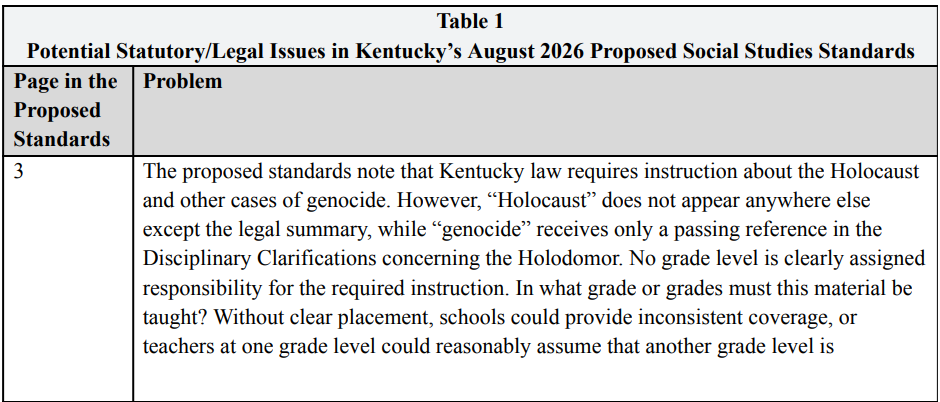
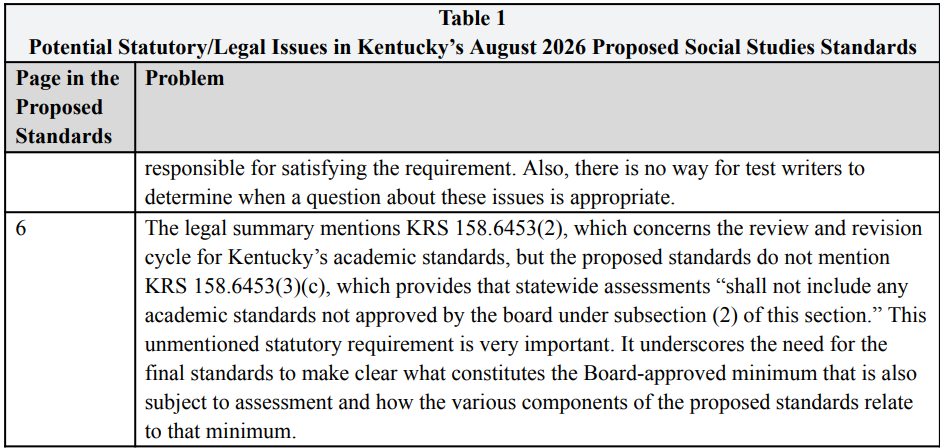
The Board needs to determine precisely which portions of the incorporated document constitute Kentucky’s “minimum content requirements.” The final standards should make the board’s decision clear to all.
Kentucky can and should leave room for districts and teachers to make local curriculum and instructional choices beyond the statewide minimum. But meaningful local flexibility requires a clearly defined starting point: Exactly what minimum knowledge and skills has Kentucky determined every student should learn?
The proposed standards do not answer that question with sufficient clarity.
Missing social studies disciplines: A major problem with the proposed Kentucky social studies standards
Omissions in the proposed social studies standards are evident even at the most basic level of inspection.
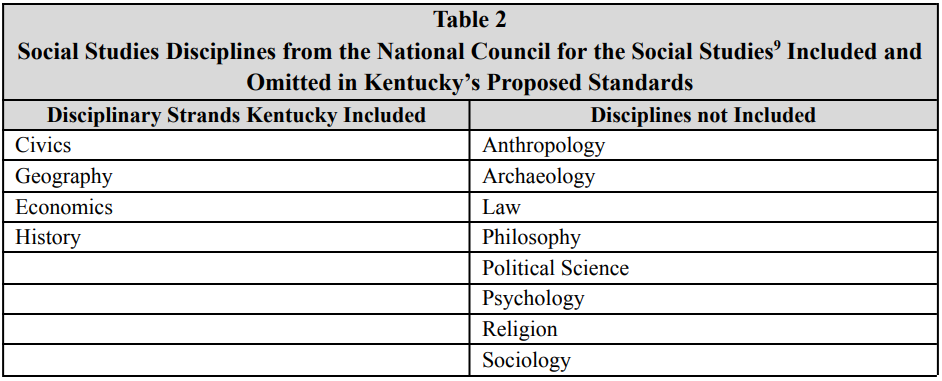
According to the National Council for the Social Studies, social studies includes at least 11 separate disciplines. The council’s website discusses:
the integrated study of the social sciences and humanities to promote civic competence. Within the school program, social studies provides coordinated, systematic study drawing upon such disciplines as anthropology, archaeology, economics, geography, history, law, philosophy, political science, psychology, religion, and sociology, as well as appropriate content from the humanities, mathematics, and natural sciences.
However, the “Design Considerations” found on page 7 in the August 2026 proposed standards indicate that social studies for Kentucky has only four disciplinary strands: civics, geography, economics, and history. The other disciplines are either unmentioned or seriously downplayed. For example, “anthropology” and “sociology” are never even mentioned anywhere in the proposed social studies standards. Why are these important disciplines, recognized by a national organization specializing in social studies, either being ignored completely or at least seriously downgraded in importance in Kentucky’s proposed social studies standards? What is the rationale for these decisions?
Overall omissions of basic social studies content are massive
The standards send a strong message that student-centered processes trump content. This is an especially damaging message considering that research from Susan Pimentel, Daniel T. Willingham and others increasingly shows that content knowledge in social studies is as crucial for basic reading proficiency as it is for true social studies understanding.
Some examples of what is missing or deemphasized include:
The selection of historical figures is incomplete and inconsistent
Jeff Shaara, an award-winning historical novelist, could easily point to one of the important considerations in developing social studies standards. In the introduction to his novel, A Blaze of Glory, Shaara says:
If you have read any of my books, you know that these stories are driven not by events, but by characters. For me, the points of view of the characters in this story are more appealing than the blow-by-blow facts and figures that are the necessary products of history textbooks.
As Shaara knows, information about the personalities involved in history enlivens and fleshes out the story best.
While the proposed standards do add some additional historical figures beyond what the current, December 2022 document already lists, there remains a disturbing lack of coverage of numerous other important historical figures. These omissions include the majority of U.S. presidents such as John Adams, Andrew Jackson, Dwight Eisenhower and John F. Kennedy, to name just a few.
In addition, it is difficult to determine the principle used to decide which people are specifically named and which are omitted. Numerous key historical figures every Kentucky child should learn about are not named.
The issue, therefore, is not that the proposed standards ignore historical personalities altogether. Rather, the selection of historical figures is incomplete and sometimes inconsistent.
Further insight into these omissions comes from a comparison with the 2018 Massachusetts social studies standards, which is discussed further below.
Note: Massachusetts titles its standards as a “framework,” but the Massachusetts document is actually similar to the “standards” used in Kentucky because the Massachusetts document outlines what’s fair game on that state’s assessments.
Massachusetts is a particularly appropriate comparison because page 7 in the proposed Kentucky standards says the 2018 “History and Social Science Curriculum Framework: Grades Pre-Kindergarten to 12” for the Massachusetts Department of Elementary and Secondary Education was explicitly provided to the Kentucky draft team as a reference.
In contrast to Kentucky’s proposed social studies standards, the Massachusetts framework directly names many important historical figures that Kentucky leaves unspecified.
This does not mean Massachusetts made every choice Kentucky should make, nor that Kentucky should simply copy Massachusetts’ list. However, the comparison raises an important question: Why were some significant figures included in Kentucky’s proposed standards while numerous others appearing in one of the drafting team’s own reference documents were omitted? What logic was used to make those decisions?
In particular, the proposed standards omit many individuals of note from science, invention, and industry
It is important to note that virtually all the key players in the story of American science, invention and industry are missing from Kentucky’s proposed social studies standards.
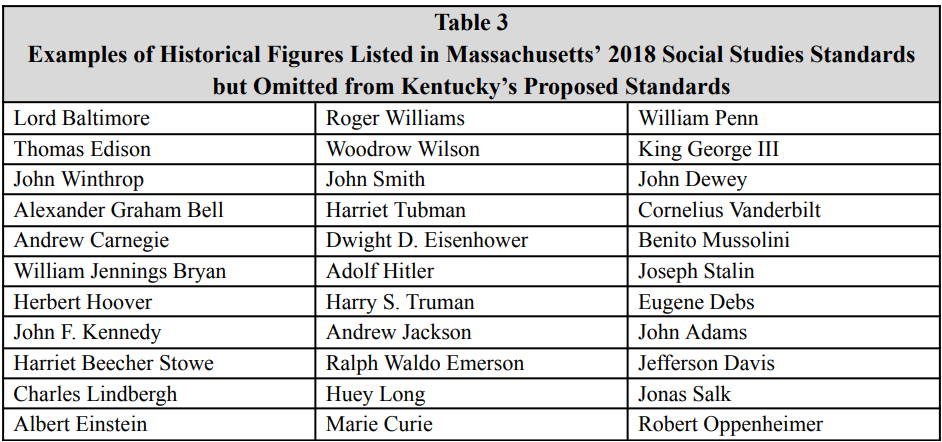
The proposed standards make no mention of important inventors such as Alexander Graham Bell and Thomas Edison, to name just two examples. Both are included in the Massachusetts standards.
Important industrialists also are ignored.
These are not merely names to memorize. A discussion of individuals such as Bell, Edison, Jonas Salk, Andrew Carnegie and Cornelius Vanderbilt can help students understand industrialization, technological change, medical advancement and the transformation of American society and the economy.
More specific examples of omitted historic figures
Table 3 shows just a few of the historical figures included in Massachusetts’ 2018 social studies standards but omitted from Kentucky’s proposed standards. The point is not that Kentucky must include every person Massachusetts names. Rather, the comparison illustrates the extent of the choices Kentucky has left unspecified and the need for a more deliberate and coherent approach to determining the historical figures that should form part of every Kentucky student’s common knowledge.
Key inventions such as the printing press, the telephone, the polio vaccine, the atomic bomb and television are not in Kentucky’s document, either, despite being listed in the Bay State’s standards.
Certainly, Kentucky’s educational leaders should be able to agree on a reasonable set of historical figures and crucial inventions that all Kentucky students deserve to know. No standards document can or should name every important person or invention. But the proposed standards should identify a coherent minimum while leaving teachers and districts free to go beyond it. The current draft does not make it sufficiently clear what that minimum is, how it was determined or why many historical figures considered important in the reference documents somehow are not important in Kentucky.
Inconsistent choices of historical figures
Given the numerous important historical figures unmentioned in the proposed standards, the selection of the historical figures that are specifically named in the proposed standards raises questions about the principles used to determine who is included.
A curious inclusion in the proposed standards deserves mention. Page 204 in the proposed standards mentions Mary Willie Arvin, “a nurse who received honors from three allied countries for service during World War I.” However, no leaders, such as President Woodrow Wilson or General John Joseph Pershing, commander of all the American Expeditionary Forces in World War I, are recognized. That seems incredibly unbalanced, at best.
This also raises problems with the legal requirement that anything on the state test must be in the standards. A question about Nurse Arvin could be fair game on the state’s assessments. Specifically, because Arvin is mentioned by name but Pershing is not, a question about Pershing is likely not legal on the state’s assessment, and teachers might not think it would be likely to appear there, either.
A lot more than historical figures gets ignored
Aside from a dearth of historical personages in the proposed social studies standards, drilling a bit deeper shows that some interesting Kentucky history is missing.
- The Battle of Blue Licks, one of the last skirmishes of the American Revolution, which was fought on Kentucky soil, is unmentioned.
- The War of 1812 is also totally omitted from the proposed standards. Notably, the Kentucky National Guard’s history website says that “Sixty-four percent of the Americans killed in the War of 1812 were Kentuckians.”
There’s also a significant omission of key terminology, particularly so for geography. While a few mapping terms such as “longitude” and “latitude” appear, many additional terms of importance, such as “equator,” “Greenwich (or Prime) Meridian,” “topographic map,” “volcano,” “North Pole” and “South Pole,” are absent from the entire kindergarten through Grade 12 coverage.
The Geography Framework for the 2018 National Assessment of Educational Progress, a NAEP document, is listed as another reference on page 7 of the proposed standards. This NAEP framework lists many items such as the “equator,” “complex map projections,” and numerous other physical features like “rain forests” and the location of New York City as expected knowledge. The proposed standards never mention these terms and therefore do not ensure that all Kentucky students will encounter this content as part of the statewide minimum. This raises further questions about how thoroughly the reference documents were considered in developing the proposed standards.
More awkward omissions
Awkward omissions are found in other parts of the document, as well. Consider the material presented for Kentucky’s Revised Standard for First Grade, 1.C.KGO.2 “Investigate how a community is shaped by symbolic figures, places and events.” The Disciplinary Clarifications section of the proposed social studies standards on page 39 reads:
Community can be shaped by historical figures from the state, local communities and unique places, which may include, but are not limited to, Churchill Downs, Mammoth Cave, the Appalachian Mountains, school mascots, school events and local festivals.
How will local curriculum developers interpret this puzzling clarification that actually lists some specific places in Kentucky, like Mammoth Cave and Churchill Downs, yet fails to mention any single historical personage? How will test writers know what to include among those things that shape the community of the Bluegrass State? Furthermore, since virtually nothing is specifically listed, doesn’t this lack of specificity severely limit what can appear as a valid test question on the state’s assessments?
This vague standard could result in over 170 vastly different answers — one for each school district in the state — about which, if any, historical figures and events each first-grade student in Kentucky will learn about. The standard is far too vague to establish anything approaching a common minimum core of social studies knowledge across the commonwealth.
Why does interest in South America largely fade after 1750?
The term “South America” appears only twice in the proposed social studies standards and only in relation to the period before 1750. It is as though this entire continent mostly ceased to exist after that.
A major historical personality from South America, Simón Bolívar, is also absent from the proposed standards although he is mentioned multiple times in the 2018 History and Social Science Framework from Massachusetts.
Such omissions clearly invite limited discussions about this major continent and have major implications for what might appear in questions on the state’s assessments.
Notably, the term “South America” is found 22 times in the 2018 framework from Massachusetts.
Key Vocabulary listings seem incomplete
Along these lines, the “Key Vocabulary” listings for each grade are trivial and incomplete. The entire listing for Grade 3 on page 57 includes just 19 items for the entire year. Furthermore, the proposed social studies standards only say the actual curriculum “may” include these terms. So, these terms are not presented as mandatory knowledge. True standards cannot be written in this indeterminate manner. What will test creators do with this?
Lost standards
Amazingly, some of Kentucky’s earlier social studies standards had items that no longer appear in the proposed standards. Table 4 shows some examples.
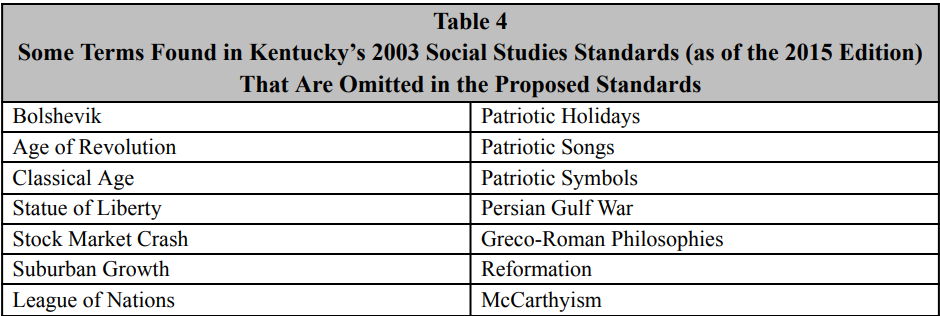
Recall that Kentucky law requires statewide assessments to align with the academic standards approved by the Board. When important terminology is omitted, teachers and districts are left guessing about an important question: Is this part of the minimum content Kentucky expects every student to learn, or is it left to local discretion and won’t be tested?
Clearly, massive omissions in the proposed social studies standards force far too many assumptions on those who must develop curriculum or assessments for social studies. The potential for substantial variation in what gets presented in different Kentucky classrooms is easy to envision.
Table 4 provides good evidence that decisions about the proposed standards need more explanation.
Technical issues
- Page 184 in the proposed standards says, “Willa Beatrice Brown was the first African American woman in the United States to earn a pilot’s license.” Technically, Bessie Coleman, another African American woman, earned her pilot’s license much earlier, in 1921, though it was awarded after she completed training in a French school, as prejudice at that time prevented her from enrolling in an American flight school. 17 Brown didn’t earn her first license until 1938, though she also went on to earn a commercial license, reportedly becoming the first African American woman to hold both certificates. 18 But the honor of being the first African American woman to hold any pilot’s license goes to Coleman. A more accurate statement would be:
“Willa Beatrice Brown, who was born in Glasgow, Kentucky, was the first African American woman to earn a pilot’s license in the United States.”
- The date of Booker T. Washington’s Atlanta Exposition Address is 1895. It is incorrectly identified on pages 172, 177, 272 and 279 in the proposed August 2026 standards, though it is correctly listed elsewhere in the document.
Content sequencing and grade-level placement deserve reconsideration
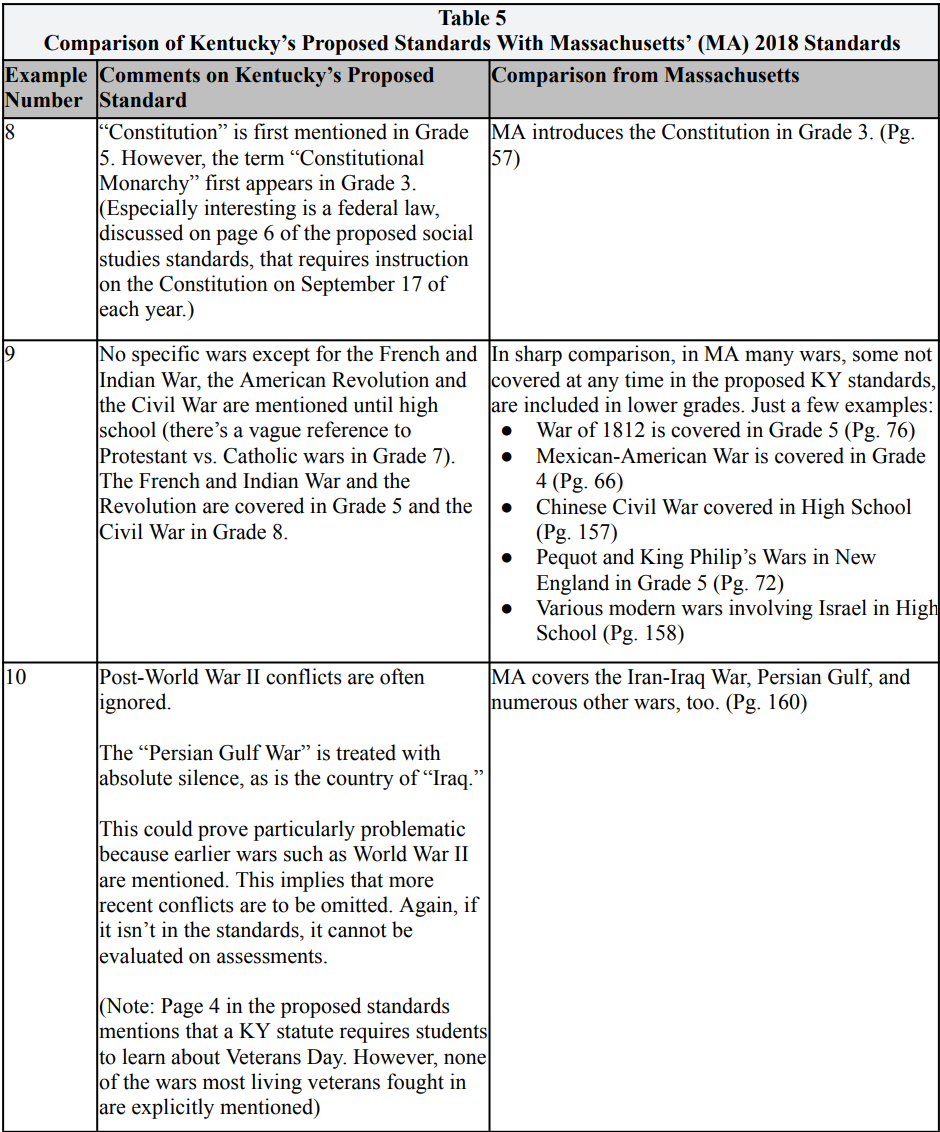
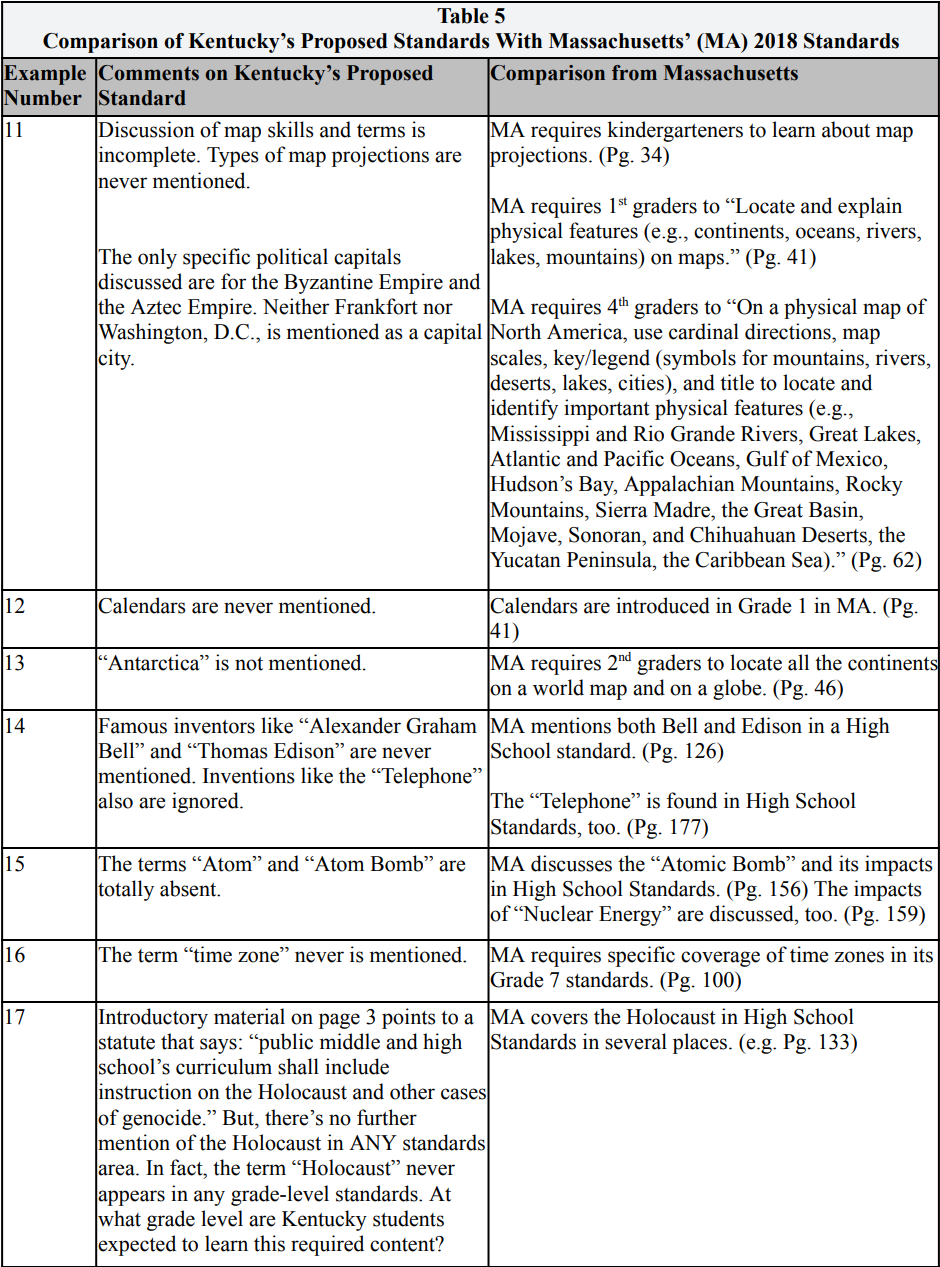
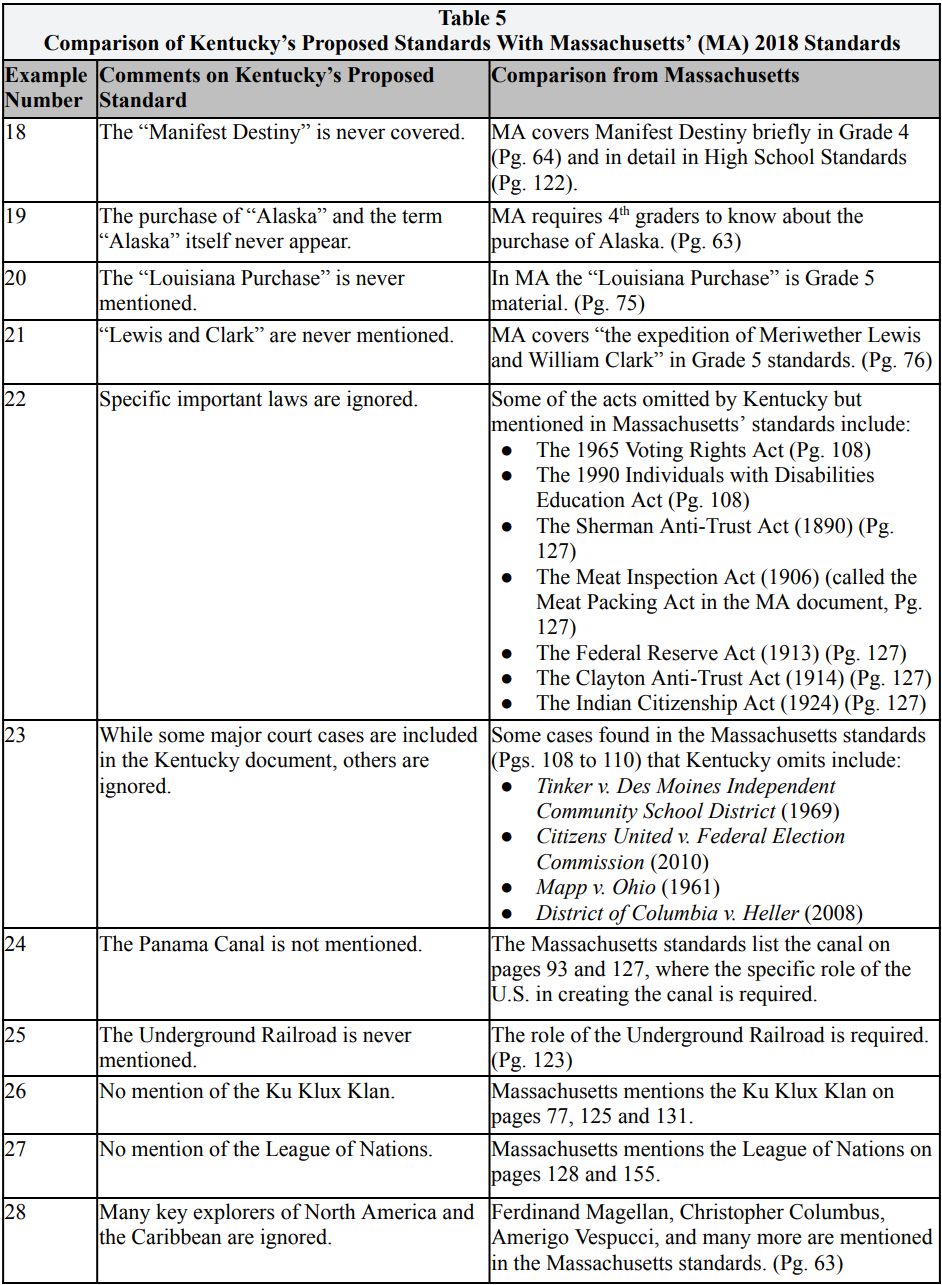
There are certainly concerns about the age appropriateness of some material. In a comparison of the proposed standards with the Massachusetts 2018 standards, it wasn’t hard to find numerous examples of things specifically included in the standards from the Bay State that go completely unmentioned in the proposed social studies standards. However, even when subjects are covered in Kentucky’s proposed standards, they tend to be introduced to students several grade levels later than is typical in Massachusetts. Table 5 summarizes some examples.
Table 5 identifies some specific material either completely ignored in Kentucky’s proposed standards or introduced in later grades than it is in the Massachusetts 2018 Framework. A number of these examples, such as Kentucky’s omission of the Lewis and Clark Expedition, are particularly concerning.
Massachusetts does not necessarily establish all of the correct grade placements for Kentucky. However, because Kentucky itself identified the Massachusetts framework as a reference, substantial differences in when foundational content is introduced provide a useful reason to reconsider Kentucky’s sequencing choices.
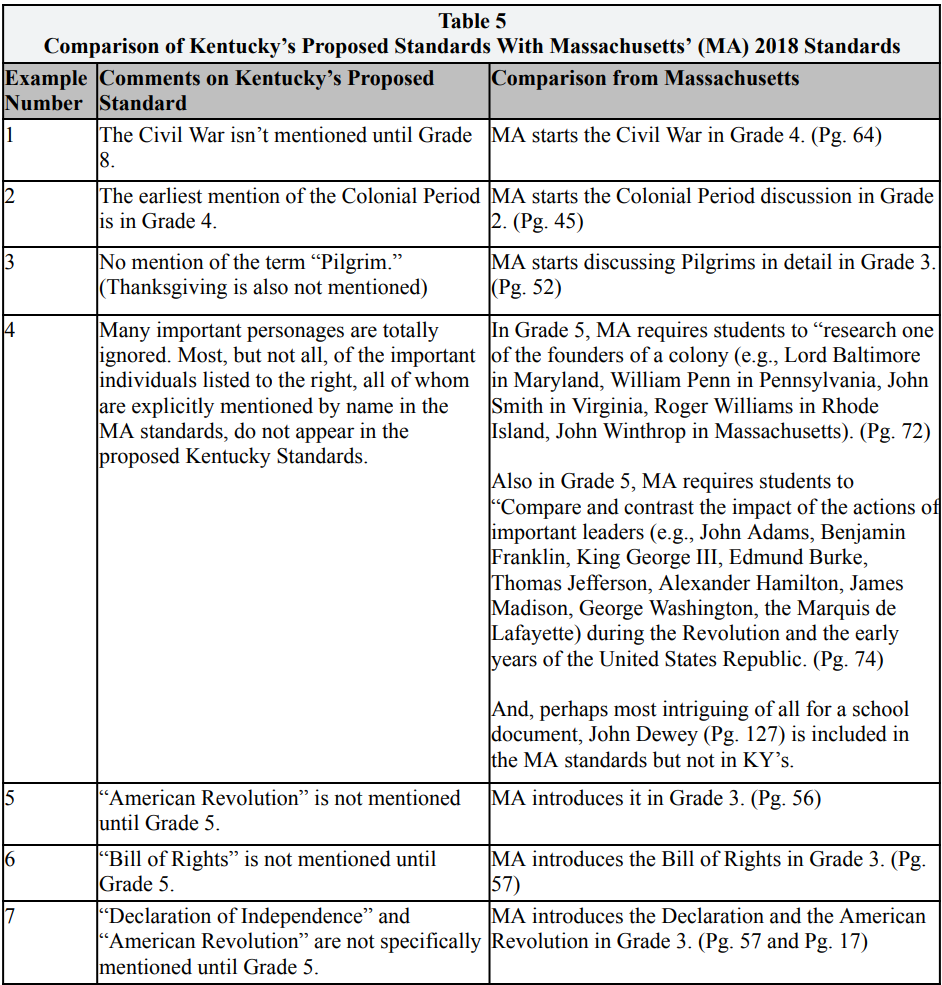

Apart from the grade sequencing issues discussed above in items such as Example Numbers 1, 2, 5, 6 and so forth, other examples in the proposed standards raise concerns about students’ readiness for the material. An example is found in the Disciplinary Clarifications for Kindergarten Standard K.G.HI.1, where the proposed standards talk about “a rule posted on the wall which says to take turns when speaking.”
This is a standard for kindergarteners. If kindergarteners are being pushed to read and understand rules posted on a wall, that would likely involve sight-word reading approaches that are now considered inappropriate for beginning readers.
“Sample Evidence of Learning” sections need work
To be sure, these are very difficult to develop for social studies, but curriculum writers, teachers and test agencies need clear guidance on what student performances are expected and how good a performance is good enough. Most of the Sample Evidence examples don’t provide clear and specific information to those educators, and especially so to test creators. How could a test creator use the Sample Evidence of Learning sections to create valid tests? How would they determine how good a performance is good enough from the Sample Evidence of Learning examples?
Summarizing
The basic organization of the proposed standards, with extensive reliance on Disciplinary Clarifications and other imprecise elements such as the Sample Evidence of Learning examples, is fundamentally in conflict with what is required for a clear and directive set of education standards. A major rewrite is needed to fix this problem.
The proposed social studies standards also fail to provide a sufficiently clear and consistent treatment of the people behind historical events. While the standards name a number of important historical figures, many other major figures are omitted, and the rationale used to determine who is specifically included is unclear.
Lacking even a minimally acceptable listing of essential historical figures that all Kentucky students should know, the proposed social studies standards render it unlikely that students across Kentucky will gain any sort of common minimum core of such knowledge. In light of a 2019 report from the Woodrow Wilson Foundation showing that adult Kentuckians had the second-worst knowledge of U.S. history among the states surveyed, this deficiency is particularly troubling.
While determining which names should be included or excluded from a set of social studies standards is indeed challenging, other states, such as Massachusetts, have faced up to the challenge. There simply must be an agreed upon minimum core of historical personalities all students in Kentucky are expected to know. Ducking the responsibility for creating that minimum isn’t acceptable.
The proposed social studies standards create another problem regarding included and omitted historical personalities. Because some personages, such as Washington and Sam Adams, are mentioned, there’s an implication that the omitted persons are intentionally not included. As such, the language from Senate Bill 1 of the 2017 Regular Session, which says things not in the approved standards cannot be tested, comes into play very strongly. Using the proposed standards, would it actually be illegal for a Kentucky social studies assessment to ask a question about Adolf Hitler? Do we want standards that create such uncertainties?
Overall, there’s simply no question that Kentucky’s proposed standards for social studies need more work and are seriously deficient in their current form.
What should be done?
The Kentucky Board of Education should take a few minutes just to read pages 61 to 66 in the 2018 Massachusetts standards. These cover a portion of the requirements for fourth-grade social studies in the Bay State. The board should easily be able to see, even from just this short sample, how Kentucky’s proposed standards are far less clear and detailed about what students are expected to know.
With a better appreciation of what needs to be done, the Board should require a major rewrite of the proposed standards before 704 KAR 8:060 and the August 2026 standards incorporated by reference become Kentucky’s final governing framework for social studies.
That rewrite should address the extensive use of “may” and similar optional language. Where material is part of Kentucky’s required minimum content, the standards statements must be written in a way that does not require a lot of guessing and that makes it clear the material is not optional and is expected to be presented to all students. “May” can appropriately identify illustrative examples or possible instructional approaches, but the final document must clearly distinguish those optional examples from required content.
The Board and KDE should also clearly identify which portions of the incorporated document constitute Kentucky’s “minimum content requirements.” Are those requirements contained only in the standards statements, or do they also include the Disciplinary Clarifications, Key Vocabulary and Sample Evidence of Learning? The status of the Disciplinary Clarifications is especially important because much of the specific content in the document appears there. The Board and KDE should make clear whether those clarifications are final. If the board is contemplating more changes for required content, those changes need to be made before an adopting regulation is submitted, not afterward.
The reference documents need careful reconsideration, especially the listings of historical events, personalities, geographic knowledge and other content that the proposed standards currently lack. A very conscious evaluation process should be used to determine why significant items in the formally listed reference documents are not needed in Kentucky. Kentucky certainly does not need to adopt every item included by Massachusetts, Louisiana or another reference, but omissions should reflect deliberate decisions about what Kentucky students need to know.
Throughout the rewrite, drafters must constantly remind themselves that this document will specify the minimum each Kentucky student should receive regardless of where they live in the state. The document also provides the standards to which the state assessment must be aligned. Important questions about that statewide minimum should therefore be answered in the standards themselves rather than left to subsequent nonbinding guidance or optional curriculum materials.
One approach to doing the rewrite would be to use the Massachusetts 2018 document for a systematic content cross-check, adding missed items such as those covered by Louisiana, which is also listed as a reference, and the other reference documents. The purpose would not be to copy another state’s standards, but to make informed and conscious decisions about important content: What should every Kentucky student know, and when should every Kentucky student know it?
Finally, if the board continues to process 704 KAR 8:060, adopting the August 2026 document, the concerns in this comment paper should be considered during the regulatory review of 704 KAR 8:060 by the Administrative Regulation Review Subcommittee and the Interim Joint Committee on Education. In particular, legislative reviewers need to consider whether the document incorporated by reference clearly establishes acceptable “minimum content requirements.” Legislators should not accept promises to make further changes to the standards after adoption as this would compromise the entire regulatory review process, particularly by locking out further public comment.
In closing
Development of solid education standards is extremely hard work. However, those standards become the cornerstone around which all the other elements of our education system are built, including curriculum, classroom instruction, and expensive state assessments. Incomplete and unclear standards invite uneven classroom instruction across the state and make it more difficult to evaluate whether the standards are being met. Thus, the state’s social studies standards deserve as much time and attention as we can provide them. Students and teachers deserve better than the proposed standards provide, and that needs to change.
Richard G. Innes, Staff Education Analyst
Bluegrass Institute
301 Washington St.
Shelbyville, KY 40065
Cell: 859-466-8198
E-Mail: 70224.434@compuserve.com