
Table of Contents
When we think about the American Dream, we think about social mobility. Social mobility is a simple idea: Your life outcomes should largely be unrelated to your parents’ status. If you were born into poverty or another precarious situation, you should have the opportunity to achieve wealth and stability. At the same time, being born to rich parents should not guarantee success. When societal institutions are strong, fair, and transparent, they facilitate upward social mobility.
Whether the American Dream is still alive today is widely debated, and those debates inevitably circle back to one thing: Success often does depend on where you were born and whom you were born to.
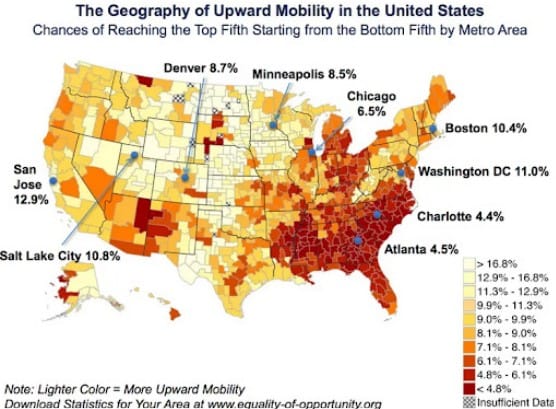
Harvard economics professor Raj Chetty and his research team at Opportunity Insights provide a simple example. The chances of someone born in the bottom quintile of the national income distribution charting a path to the top quintile vary widely by area. If you were born in Atlanta, your chances are 4.5%; however, your chances if you were born in San Jose (12.9%) are nearly three times higher. Individuals born in Salt Lake City (10.8%) have roughly the same chance as those born in Boston (10.4%) or Washington, DC (11%). Most areas in Kentucky, with chances ranging from 5.2% (Louisville) to 13.1% (Pikeville), fall in the bottom half of the national rankings.
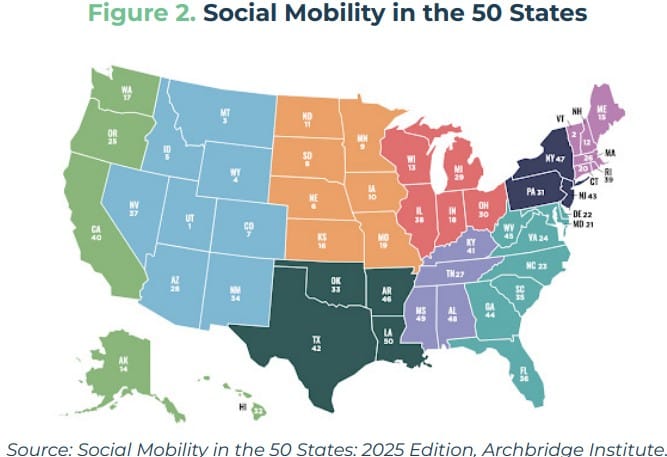
Archbridge Institute, a think tank focused on solutions to upward mobility, recently published its Social Mobility of the 50 States report that shows similar disparities (see figure 2). In the most recent edition (using mostly 2023–2024 data), Kentucky ranks 41st—in the bottom 10 of all states.
In this three-part series on the state of social mobility in Kentucky, we will begin by examining the Institutions and Rule of Law pillar in the Social Mobility of the 50 States report. In the remaining series, we will focus on the Environment for Entrepreneurship and Economic Growth pillar, and the Education and School Freedom area.
Educate your inbox. Get the Bluegrass Institute's once-weekly policy update.
Why Institutions and Rule of Law Matter
Institutions provide the rules of the game to society, and decades of research show that legal systems, property rights protection, and the rule of law are among the strongest predictors of economic growth. Having strong and fair institutions, through low corruption, high quality legal systems, and less predatory state action, is essential for social mobility. When the rules favor one group over another, they usually benefit the group that already has a higher status. The disfavored group is often left with fewer opportunities, greatly lowering its chances of achieving upward mobility.
Corruption is one manner in which elite groups benefit at the expense of the rest of society. A large body of evidence finds that corruption increases inequality and social exclusion, decreasing social mobility. Transparency International, a research institution focused on combatting corruption around the globe, puts it bluntly in a 2017 study: “Corruption leads to an unequal distribution of power in society which, in turn, translates into an unequal distribution of wealth and opportunity.”
Predatory legal systems follow the same throughline: using state-sanctioned force at the expense of everyday citizens. For example, civil asset forfeiture schemes often make it possible for police agencies to confiscate assets without an official charge of the crime. Historically, this has come at the expense of those with less socio-economic status. This boosts the police agencies’ own revenue while taking property of its citizens. Similarly, overly burdensome fines and fees incentivize revenue collection over addressing public safety.
A 2023 paper by the author (with economist Vincent Geloso) shows a similar conclusion: Places with greater economic freedom have notably higher social and income mobility, and the effect is stronger where legal systems are stronger and property rights are better protected. States with more just and less predatory legal systems allow for the development of skills, capital, and opportunities that make it more likely for individuals to achieve upward mobility.
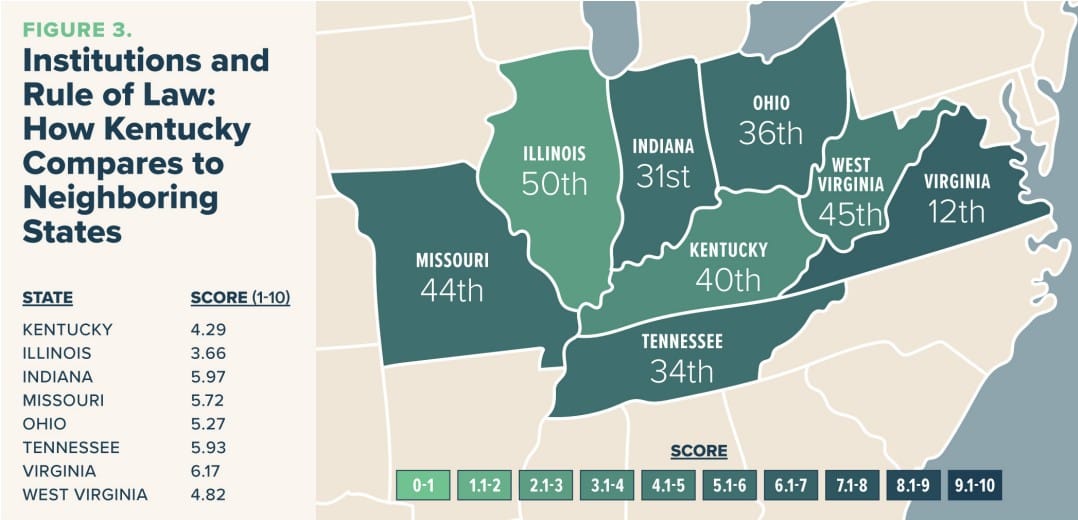
The opposite is also true. States with corrupt and predatory legal institutions lock the poor into their socioeconomic status, leaving opportunities to those with political connections and the skills needed to maneuver through an elaborate bureaucratic system. These skills are then used for “unproductive” entrepreneurship (lobbying and political favoritism) that decreases economic growth and prosperity. Kentucky, unfortunately, ranks low (39th) on the Institutions and Rule of Law pillar in the Social Mobility of the 50 States report. In a country whose judicial system is based on the principle of “innocent until proven guilty,” states that fail to uphold this ideal tend to harm the poor the most.
Comparing Kentucky to Its Neighbors: Institutions and Rule of Law
Compared to its seven bordering states—Illinois, Indiana, Missouri, Ohio, Tennessee, Virginia, and West Virginia—Kentucky has the second-lowest score on the Institutions and Rule of Law pillar—better only than Illinois (see figure 3).
The Institutions and Rule of Law pillar is made up of two subpillars.
- Predatory State Action: The average of (1) total fines and fees collected by local governments per capita, (2) corruption perceptions, and (3) civil asset forfeiture policies.
- Judicial System Quality: The average of (1) access to justice, (2) quality of the state liability system, and (3) tort costs as a share of GDP.8
Predatory State Action
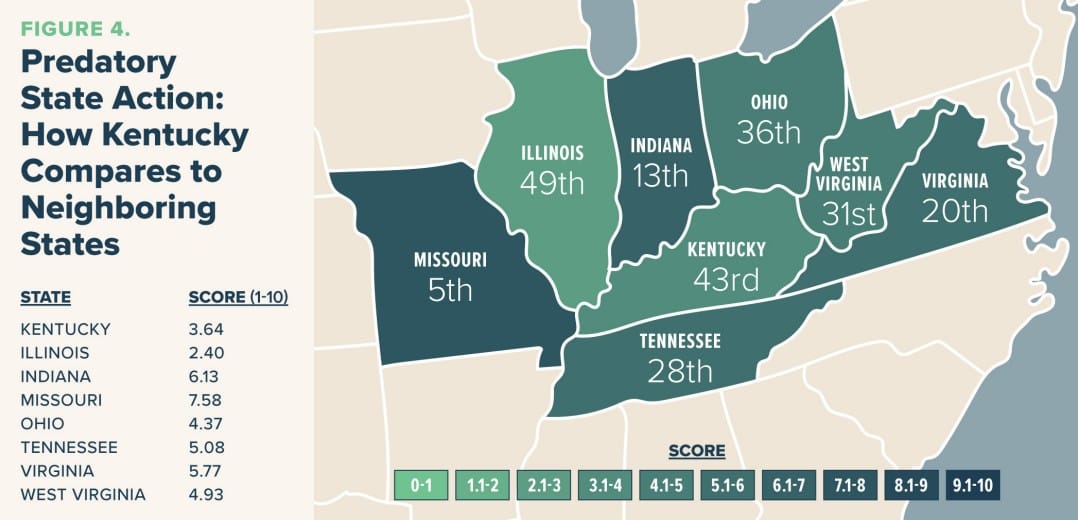
Among its neighbors, Kentucky performs poorly on Predatory State Action, again ranking above only Illinois.
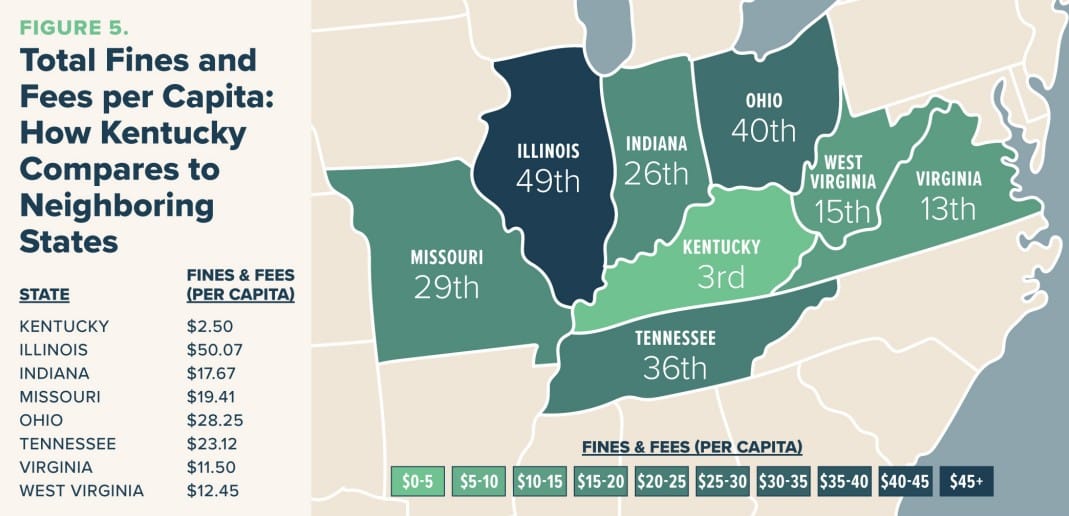
Kentucky’s brightest spot in this pillar is its exceptionally low level of fines and fees per capita (see figure 5). Fines are typically imposed upon conviction for failing to comply with an ordinance, from speeding tickets to lawn care citations. Fees, or “user fees,” are a form of revenue generation rather than a penalty for failing to follow some law. This includes costs associated with one’s right to due process, with some examples being courtappointed attorney fees, supervision fees, drug testing fees, and rental fees for electronic monitoring devices. These occur regardless of if the person was actually guilty of the crime that they committed. Such fees are more encumbering for someone with less economic means. Kentucky collects just $2.50 per person—the 3rd lowest in the country.
Corruption
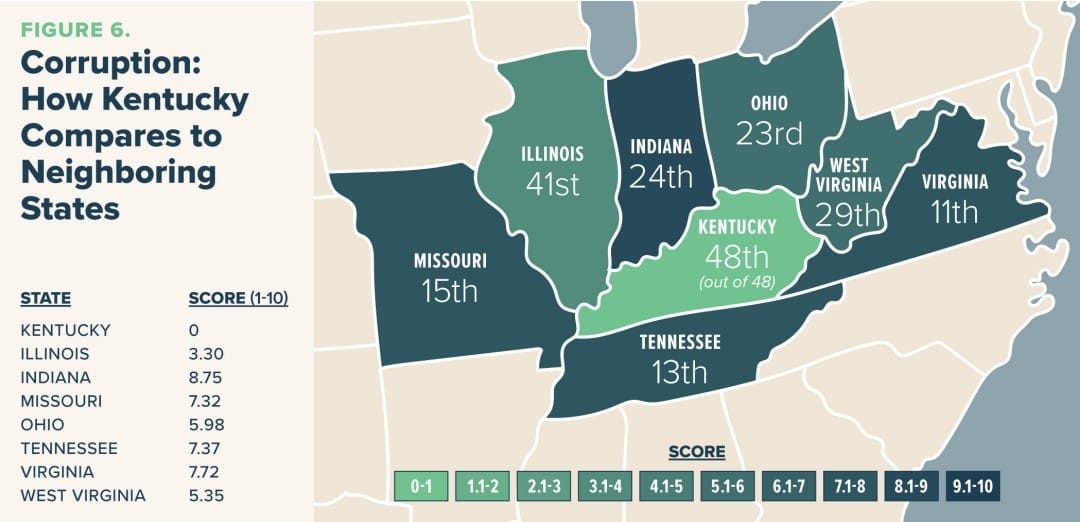
Unfortunately, Kentucky scores the lowest in the country on corruption perceptions (see figure 6). These ratings come from a survey of journalists across the country who were asked to rate states on both “legal” and “illegal” corruption within the state they report on.9
- Legal corruption refers to political favoritism that is technically lawful—campaign contributions or endorsements exchanged for special benefits to groups and individuals—but is morally suspect.
- Illegal corruption refers to public officials providing private gains (quid pro quos) in the form of cash, gifts, or other favoritism in return for specific benefits to others.
Reporters were asked how common each type of corruption is—with five options ranging from “not at all common” to “extremely common”—across the executive, judicial, and legislative branches in each state.
Corruption was perceived as very or extremely common in several areas within Kentucky:
- Illegal corruption in the legislative branch was perceived as very common.
- Legal corruption in the executive branch was perceived as extremely common (New Jersey was the only other state perceived this way).
- Legal corruption in the legislative branch was also rated extremely common.
- Perhaps most concerning, Kentucky was one of only a few states to be perceived as having moderately common legal corruption in the judicial branch.
Kentucky had a famous instance of corruption through the FBI investigation Operation Boptrot, where 15 state legislators were convicted of various corruption-related charges. Despite this occurring in the early 1990s, the perception of corruption has not fully faded.
Civil Forfeiture
The final variable in the Predatory State Action subpillar is civil forfeiture—arguably the clearest example of state predatory behavior toward its citizens. Under civil forfeiture, states can seize and keep property—homes, cars, cash, even things like TVs and taxidermy pieces—based solely on probable cause, without ever securing a criminal conviction.
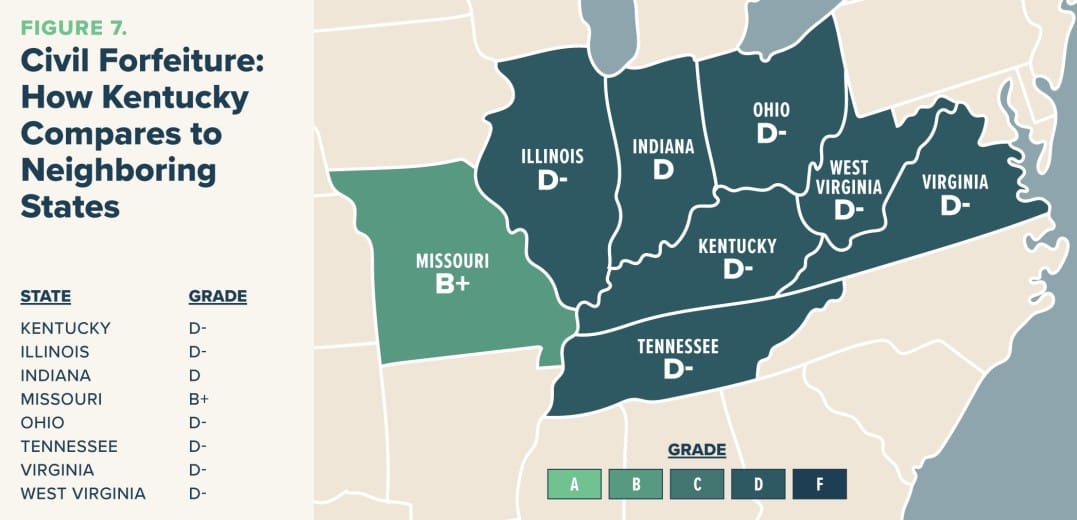
Kentucky earns a D- from the Institute for Justice (IJ) for its civil forfeiture laws—tied with 28 other states for the 2nd lowest score. (Only Massachusetts received a lower grade, an F). Among Kentucky’s neighbors (see figure 7), all but two also received a D-. Indiana does slightly better with a D, while Missouri stands out with a B+, tied for the 3rd best grade nationally.
Kentucky requires owners to prove their property’s innocence, not only flipping the standard of “innocent until proven guilty” but requiring an inanimate object, the seized property, to be the defendant in civil forfeiture cases.
“Slight evidence of traceability” is enough to justify the government’s seizing property and keeping it. Only for real property—such as land—is the standard higher at “clear and convincing evidence.” Worse still, Kentucky allows forfeiture even if the owner is never convicted or even charged.12 Combined with the fact that agencies are able to keep 100% of the forfeiture funds, the state has created both a low barrier to seize property and a strong financial incentive to do so.
Kentucky is one of the few states that combines all four of the worst possible features of a civil forfeiture regime:
- Lowest evidentiary standard
- Burden placed on innocent owners to prove their property is not guilty
- 100% profit incentive for agencies
- No conviction requirement
From 2007 through 2023, Kentucky state and local agencies took over $65 million through civil forfeiture. From 2000 through 2023, they took another $152 million by circumventing state law to work with federal agencies under federal civil forfeiture law.
Policy Proposals
We offer two areas of reform to improve institutions and the rule of law in Kentucky, focusing on reasonable solutions in the areas where Kentucky scores nearest to the bottom nationally
Unwind Kentucky’s Civil Forfeiture Scheme
We recommend two reforms regarding civil forfeiture. First, Kentucky should end civil forfeiture altogether and replace it with a criminal forfeiture process. No one in the Commonwealth should lose their property without being found guilty of a crime. Due process preserves property rights without an increase in crime or a decrease in arrests.
Short of that, Kentucky could adopt modest reforms by raising the evidentiary standard the government must meet to keep someone’s property. The current “slight evidence of traceability” should be changed to “beyond a reasonable doubt” or at least to a “moderate conviction” provision (which could hinge on the conviction of anyone tied to the property, not necessarily the owner). By shifting the burden back where it belongs—onto the state—these reforms would provide an avenue for wrongfully seized property to be returned to owners.
Second, if Kentucky maintains a civil forfeiture scheme, we recommend improving transparency and accountability requirements. According to the Institute for Justice, Kentucky requires scant information collection for seized property and no information collection regarding how the funds from those seizures are spent. Kentucky law enforcement agencies should be required to track relevant data, including the following:
- date that the property was seized
- alleged crime that led to seizure
- crime that the suspect was charged with (if any)
- whether property was transferred to another agency (like the federal government)
- value of property seized
Given that agencies can self-fund through civil forfeiture, they should be required to report how those funds are spent and state law should require financial audits of such funds.
Improve Corruption Perceptions by Strengthening Transparency and Accountability
One durable way to reduce perceptions of corruption in Kentucky is to make the regulatory and permitting process transparent. Regulations, guidance documents, and permitting requirements are scattered across agencies, buried in hard-to-access formats, or unavailable altogether. This opacity creates opportunities for favoritism, discretionary enforcement, and unequal treatment—especially when well-connected actors can navigate informal channels while everyone else is left guessing.
Establishing a centralized, machine-readable regulatory database would make all statutes, regulations, guidance documents, and interpretive materials publicly accessible in one place. That centralized database would allow citizens, businesses, journalists, and lawmakers to see exactly what rules govern private behavior, where they come from, and how they change over time. Transparency alone—without granting new enforcement power—can substantially limit the conditions under which corruption thrives.
Permitting transparency would reinforce this effect by exposing how regulatory power is exercised in practice. A public permit-tracking portal would allow applicants and the public to monitor approval timelines, responsible offices, and agency performance across the state. When permit decisions and delays are visible, it becomes harder for agencies to favor politically connected applicants or stall disfavored ones.
Crucially, both reforms operate entirely within Kentucky’s constitutional framework—they do not empower the legislature to veto executive actions, but instead make regulatory activity observable. By replacing opacity with visibility, Kentucky can meaningfully reduce corruption perceptions while strengthening accountability, fairness, and public confidence in state institutions.
Justin T. Callais, PhD, is Chief Economist at the Archbridge Institute.
The Bluegrass Institute works with Kentuckians, pro-liberty coalitions, grassroots organizations and business owners to advance freedom and prosperity by promoting individual liberty, limited and transparent government, and free markets